Introduction
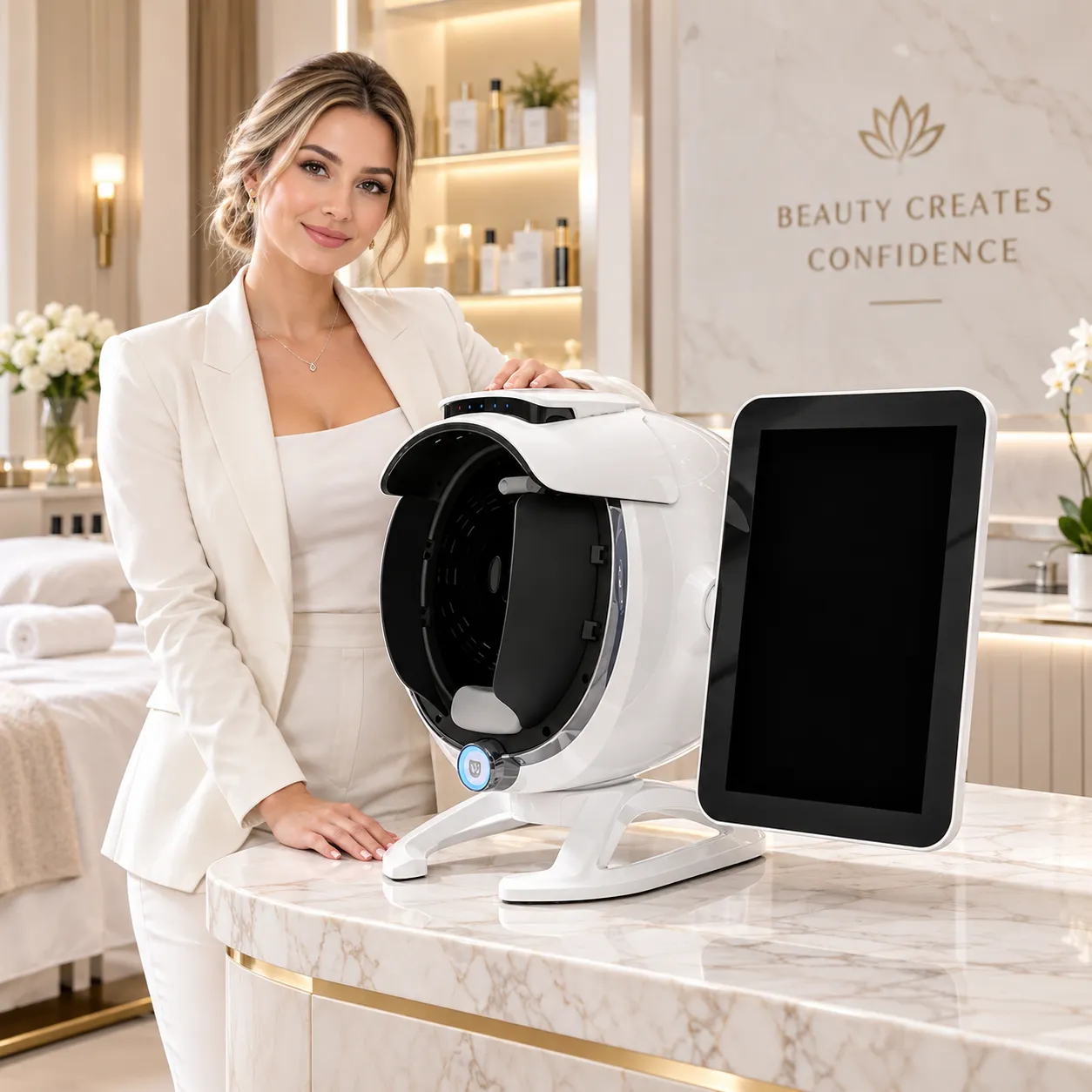
A skin analysis machine can help beauty salons understand a client’s skin condition before recommending treatments or skincare products. However, getting useful results depends not only on the machine itself but also on how the salon prepares the client, performs the scan, explains the report, and tracks changes over time.
This guide explains how to use a skin analysis machine in a beauty salon, from client consultation and skin preparation to analysis, treatment recommendations, follow-up, and before-and-after tracking.
Why Should Beauty Salons Use a Skin Analysis Machine?
1. Enhance the Consultation Experience
Traditional consultations often rely on a beautician’s visual inspection and the client’s verbal description; skin analyzers provide intuitive imagery and objective data.
2. Create Personalized Treatment Plans
Every client has a unique skin condition; salons can use analysis results to recommend skincare regimens and treatments tailored to the individual’s specific needs.
3. Build Client Trust
Clients can see their skin issues firsthand rather than relying solely on the beautician’s verbal explanation.
For example: Instead of simply telling a client they have uneven pigmentation, a skin analyzer can generate images that clearly visualize this condition.
4. **Track Skin Changes Over Time**
An initial analysis establishes a baseline profile, while follow-up scans allow for the comparison of improvements, creating a complete service loop: **Analysis → Treatment → Progress Tracking → Follow-up Analysis**
When Should a Beauty Salon Perform a Skin Analysis?
1. New Client Consultation
Conduct a skin analysis during a new client’s first visit to the beauty salon to establish an initial skin profile.
2. Before Facial Treatments or Skincare Regimens
Perform a skin analysis prior to facial treatments such as hydration, anti-aging, or skin brightening services.
3. Before Recommending Skincare Product
Analysis results help the aesthetician understand the client’s skin condition, enabling the selection of skincare products best suited for home use.
4. Before Specific Medical Aesthetic Procedures
Use skin analysis as an aid for consultation and record-keeping prior to medical aesthetic procedures such as laser, IPL (Intense Pulsed Light), or RF (Radio Frequency) treatments. While skin analyzers assist with consultation and documentation, they cannot replace a necessary professional medical assessment.
5. During Follow-up Visits
Conduct periodic skin analyses during follow-up visits to compare changes in the skin before and after treatments.
Complete Skin Analysis Machine Workflow for a Beauty Salon
Step 1 — Client Registration and Skin Consultation
Begin with a simple skin consultation to understand the client’s background and needs.
Example questions: What are your primary skin concerns? What skincare products do you currently use? Have you undergone any aesthetic treatments recently? What results do you hope to achieve?
The goal of this step is not to sell a treatment plan immediately, but to fully identify the client’s actual skin condition and goals prior to analysis.
Step 2 — Preparing the Client’s Skin
To ensure accurate and consistent scan results, proper skin preparation is essential before imaging. Salons should follow standard pre-scan procedures: remove all makeup, take off sunscreen (if applicable), wipe away heavy skincare products, and cleanse excess facial oil. If the skin feels irritated or has just been cleansed, allow it to settle before scanning.
Makeup, sunscreen, residual skincare products, facial oils, and strong ambient light can all interfere with imaging and lead to inaccurate analysis results.
Step 3 — Setting Up the Skin Analysis Machine
The aesthetician must adjust the machine and the client’s posture according to standard operating procedures. This includes adjusting the camera and equipment position, securing the client’s seated position, controlling the scanning distance, aligning facial angles, stabilizing the lighting environment, and selecting the correct imaging mode.
Consistency is the most important rule. Consistent capture settings are more critical than simply taking a clear photo. Significant differences in angles, distances, or lighting between scans will make before-and-after comparisons unreliable.
Step 4 — Capturing Standardized Skin Images
Capture multispectral skin images based on the machine’s capabilities, including standard RGB images, polarized images, UV images, and other spectral imaging modes. These various image modes help visualize a range of skin issues, such as pigmentation, enlarged pores, wrinkles, uneven skin texture, redness, excess sebum, dehydration, and UV-induced skin damage.
Step 5 — Generating the Skin Analysis Report
After imaging, the system automatically generates a comprehensive skin analysis report. The report clearly displays the client’s current skin condition, existing skin issues, key areas requiring improvement, and changes in the skin compared to previous records.
For AI-powered skin analysis devices, the intelligent system assists with image evaluation and the automatic generation of reports. However, all AI analysis results are for reference purposes only and should not be considered professional medical diagnoses.
How to Explain Skin Analysis Results to Clients
The professional interpretation of analysis results lies at the heart of skin analysis services. A qualified aesthetician should never simply hand a printed report to the client; instead, they should employ a standardized “Show – Explain – Recommend” communication model. By delivering an objective, gentle, and professional analysis, the aesthetician builds client trust and formulates tailored service plans.
1. Show — Presenting clear skin images and data
Guide the client to view the scanned skin images and analysis data directly, allowing them to gain an intuitive understanding of their actual skin condition and avoiding reliance on vague verbal descriptions.
2. Explain — Interpreting skin conditions objectively and gently
Explain the detected skin issues in a professional yet gentle tone, clarifying the underlying causes and current skin status to help the client gain a rational understanding of their skin’s needs. Avoid using negative language that disparages the client’s skin condition.
3. Recommend — Providing targeted solutions
Propose specific salon treatment plans and daily home-care advice based on the analysis results, the client’s specific concerns, and their desired outcomes. All recommendations are grounded in objective skin data, ensuring the service remains professional and persuasive.
How to Train Beauty Salon Staff to Use a Skin Analysis Machine
Regular, standardized staff training is essential to ensure that the beauty salon provides consistent, accurate, and professional skin analysis services. All aestheticians must master six core competencies to operate skin analysis devices correctly and deliver reliable results for every client.
1. Standardized Scanning
Staff must adhere to uniform operational standards when performing skin scans, ensuring consistency in client positioning, shooting distance, facial angles, lighting conditions, and imaging modes. Standardization eliminates human error and ensures that “before-and-after” comparisons are valid and reliable.
2. Basic Report Interpretation
Staff must fully understand the key metrics displayed in skin analysis reports, including moisture levels, oil content, pore status, skin texture, redness, pigmentation, wrinkles, and UV-related skin conditions. They should comprehend the significance of the data and how these indicators reflect the client’s current skin health.
3. Client Communication Skills
A key focus of training is teaching staff to translate technical data and terminology into accessible, easy-to-understand language. Staff should explain skin conditions objectively and gently—avoiding alarmist language—to help clients clearly and comfortably understand their skin status.
4. Professional Treatment Recommendations
Staff must learn to align analysis results with the salon’s existing treatment programs and skincare services. Based on each client’s unique skin concerns and improvement goals, aestheticians should provide logical, targeted, and reasonable recommendations rather than making arbitrary suggestions or engaging in aggressive upselling.
5. Client Data Management
Staff must master standardized methods for managing data records. They are required to document each client’s initial baseline skin data and images, as well as maintain complete records of follow-up scans. Well-organized skin records facilitate long-term tracking of skin conditions, comparison of treatment efficacy, and personalized client care.
6. Client Privacy Protection
All client facial images and skin analysis data constitute private personal information. Salon staff must strictly protect client privacy and manage all skin data in compliance with local privacy policies and data protection regulations. Client data must not be shared, disclosed, or used for commercial purposes unrelated to the service provided.
Common Mistakes When Using a Skin Analysis Machine
Many salons fail to maximize the value of skin analysis machines due to irregular operations and improper service habits. Avoiding these common mistakes ensures accurate test results, consistent before-and-after comparison, better client experience and higher service credibility.
1. Scanning With Makeup On
Performing skin analysis while the client is wearing makeup, sunscreen or heavy skincare products will block the real skin surface. It interferes with multi-spectral imaging, distorts skin data such as pigmentation, pores and skin texture, and leads to inaccurate analysis results.
2. Changing the Lighting Environment
Inconsistent lighting during scanning is a common cause of unreliable comparison results. Different brightness, light angles and ambient light conditions will affect image presentation, making it impossible to accurately judge real skin changes during follow-up visits.
3. Changing Camera Distance or Face Angle
Adjusting the camera distance, shooting height or client’s face angle arbitrarily during each scan will greatly affect the uniformity of imaging. Without unified shooting standards, before-and-after skin comparisons lose reference value and cannot truly reflect treatment effects.
4. Relying Completely on AI Results
AI-powered analysis is only an auxiliary tool for reference. Automated report data cannot replace professional aesthetic judgment and manual comprehensive analysis. Staff should combine machine data with actual skin observation and client feedback to make objective evaluations.
5. Not Saving the Initial Baseline Results
Some salons only provide on-site reports but fail to archive the first scan data and images. Without a complete initial skin baseline record, there is no standard for subsequent effect comparison, resulting in the loss of long-term skin tracking value.
6. Using the Machine Only Once
A single skin scan cannot reflect skin improvement or changes. The core value of skin analysis lies in continuous management through a complete service cycle: Initial Analysis + Professional Treatment + Regular Follow-Up Analysis, which helps record progressive skin improvement.
7. Turning Every Scan Into a Hard Sell
Over-promoting treatments and products immediately after scanning, or exaggerating skin problems to force sales, will make clients feel pressured. This hard-sell behavior greatly reduces client trust and affects long-term customer retention.
How to Measure the Value of a Skin Analysis Machine for Your Salon
A skin analysis machine should not be evaluated only by the number of scans performed. Its true value lies in improving consultation quality, personalized treatment planning, client trust, retention, and overall salon service experience. Salon owners can track the machine’s practical and commercial performance through the following core KPIs.
1. Number of skin analyses per month
Track monthly standardized scans for new clients, pre-treatment checks and follow-ups to measure how well the machine is integrated into daily salon workflows.
2. Consultation-to-treatment conversion rate
Monitor how many clients book treatments after a professional skin analysis. A higher rate shows that data-driven consultations build client trust and boost service sales.
3. Average client spending
Track changes in average customer spending, as personalized skin insights encourage clients to accept more targeted services.
4. Treatment package rate
Measure the proportion of clients who purchase treatment packages instead of one-time services, supported by clear skin baseline and improvement data.
5. product attachment rate
Track homecare product uptake after skin analysis. Objective skin data makes product recommendations more credible and effective.
6. Repeat booking rate
Monitor client return visits for follow-up scans and ongoing treatments, driven by continuous skin progress tracking.
7. Client retention rate
Long-term skin record-keeping and visible improvement results enhance client loyalty and long-term retention.
8. Revenue per consultation
Calculate average revenue generated from each analysis-based consultation to measure the direct business value of each client consultation.
For further reading on revenue growth, refer to: **How Can a Skin Diagnosis Machine Increase Beauty Salon Revenue?**
FAQ
How often should a beauty salon perform skin analysis?
Skin analysis should be conducted during the initial client consultation and regular follow-up visits. The exact frequency depends on the client’s skincare goals and ongoing treatment plan.
Do clients need to remove makeup before skin analysis?
Yes. Clients should remove makeup, sunscreen, and heavy skincare products before scanning to ensure clear, accurate, and consistent skin imaging results.
How long does a skin analysis take?
The duration varies depending on the device model and salon workflow. No fixed time applies to all machines, as different systems have different imaging and reporting processes.
Can a skin analysis machine diagnose skin diseases?
No. Salon skin analysis devices are designed for skin visualization, consultation, and progress tracking. They cannot provide medical diagnosis or replace professional medical evaluation.
Can I use a skin analysis machine before laser treatments?
Yes. It can be used for pre-treatment consultation, baseline documentation, and long-term progress tracking. However, it does not replace professional aesthetic or medical judgment for treatment suitability and safety.
Is a skin analysis machine suitable for a small beauty salon?
Yes. A skin analysis machine is suitable for small salons. Its value depends on whether it is integrated into daily consultation, treatment, and follow-up workflows, rather than the number of advanced features it has.
Summarize
A skin analysis machine delivers the greatest value when integrated into a salon’s full client journey, not used as a standalone imaging tool. It standardizes consultations, builds client trust, enables personalized skincare solutions, and supports long-term skin management — beyond simple photos and basic reports.
Salons can maximize results by following a complete closed-loop workflow: **Analyze → Explain → Recommend → Treat → Track → Re-analyze**. This process upgrades service professionalism, improves client satisfaction, and boosts conversion.
If you are looking for a reliable professional skin analysis machine for your salon, please contact us