Introduction
Buying a diode laser hair removal machine is a big investment for beauty salons and aesthetic clinics. However, the upfront price is only part of your total expense.
A cheap‑priced unit can end up costing more long‑term, due to frequent repairs, expensive spare parts, poor cooling performance or insufficient technical support.
For salon owners in Europe and North America, recognizing these hidden costs before buying helps you compare suppliers and work out your real return on investment (ROI).
This guide covers 8 often‑overlooked costs you need to evaluate before purchasing professional diode laser equipment.
1. Maintenance & Repair Costs
Ongoing maintenance is your first hidden expense.
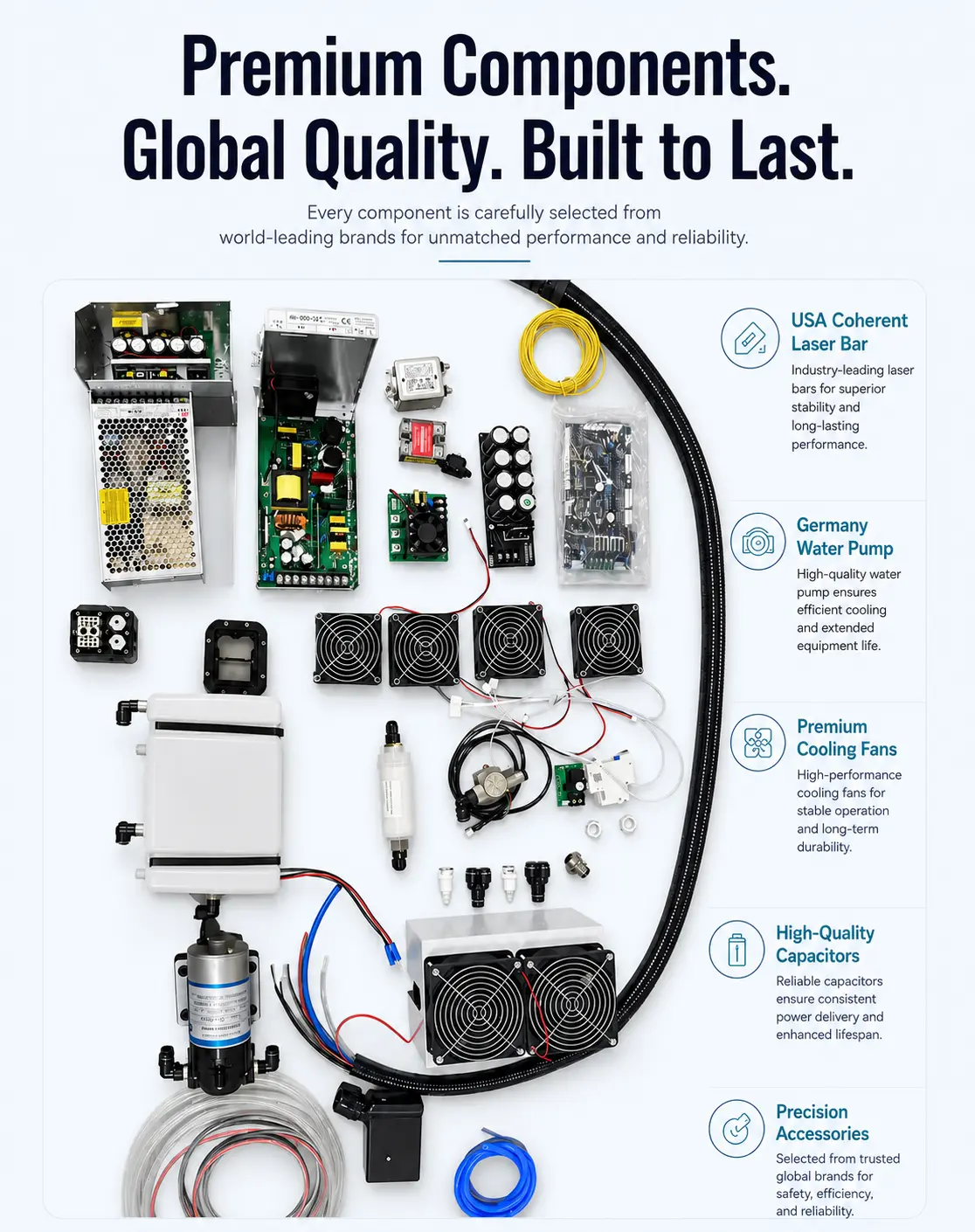
Professional laser devices consist of laser modules, cooling systems, handpieces, power supplies, control boards and other electric parts. Well‑built machines can run stably for years, but maintenance demands differ across brands and models.
Ask your supplier these key questions:
- Which parts need regular maintenance?
- What is the warranty period?
- What components does the warranty cover?
- How much are replacement parts?
- Is remote technical support available?
- Can common faults be diagnosed remotely?
Clear answers from your supplier will cut unexpected future spending.
Important check point
Do not only ask “how long is the warranty”.
Also confirm: What if the handpiece or cooling system breaks after warranty expires?
This question exposes big gaps between different suppliers.
2. Handpiece Replacement Costs
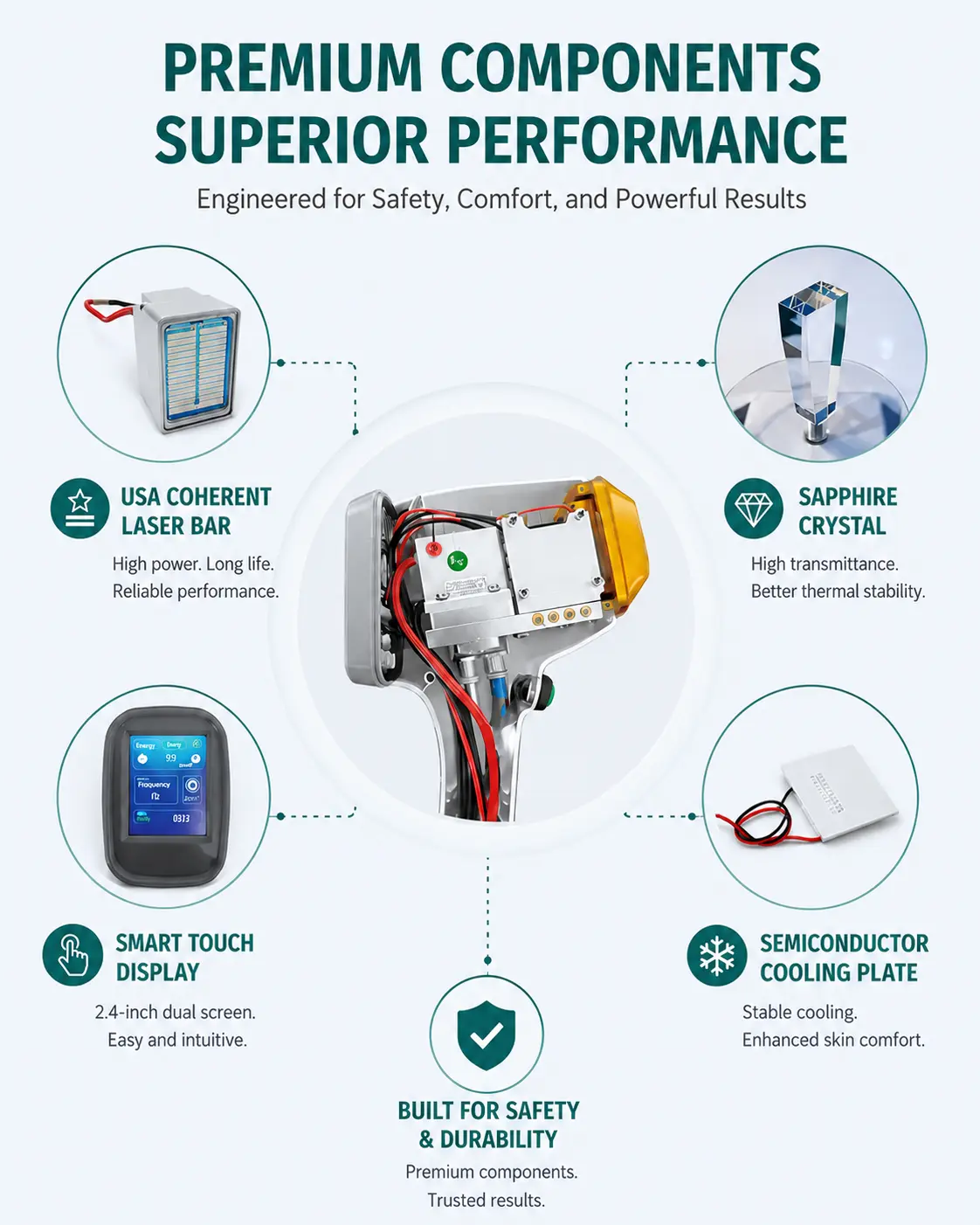
The handpiece is the most‑used component of a diode laser system.
Depending on device design and daily usage, handpieces will eventually need servicing or replacement. For high‑volume clinics, this becomes a major long‑term cost.
When comparing options, enquire about:
- Handpiece service lifespan
- Price of replacement handpieces
- Stock availability of spare handpieces
- Handpiece warranty coverage
- Cooling performance
- Treatment spot size
Sometimes paying slightly more for a machine makes better business sense, if its core parts are cheaper and easier to maintain.
3. Cooling System Related Costs
Cooling is critical for modern diode laser hair removal machines.
Contact cooling improves client comfort and protects skin during treatments. Still, cooling hardware creates ongoing maintenance work. Machines may use water circulation, refrigeration parts, semiconductor cooling or mixed solutions.
Salon owners should confirm:
- What cooling design does this machine use, and what regular maintenance does it require?
Check whether the supplier provides clear guidance for:
- Routine cooling‑system maintenance
- Coolant or water replacement
- Filter cleaning
- Temperature checking
- Basic fault troubleshooting
Good cooling improves treatment experience, yet you must understand its upkeep work before purchase.
4. Spare Parts & Consumables
Many buyers ignore spare‑part costs.
With heavy daily use, parts will wear out over time. Common replaceable items include:
Handpieces, filters, cooling components, power supplies, water pumps, fans, foot pedals, cables, safety protective accessories
Prices and stock availability vary widely from manufacturer to manufacturer.
Why spare‑part supply matters
Take two similarly‑priced machines from Supplier A and Supplier B:
- Supplier A keeps spare parts in stock and ships replacements fast.
- Supplier B needs weeks to source replacement components.
Even with equal upfront prices, Supplier B carries higher business risk. Machine downtime means cancelled appointments and direct revenue loss. For salons, downtime equals real cost.
5. Operator Training
Even top‑grade machines depend on skilled operators. Training counts toward your total investment.
New staff need to learn:
- Basic machine operation
- Parameter setting
- Skin assessment
- Pre‑treatment preparation
- Handpiece handling
- Cooling adjustment
- Daily cleaning & maintenance
- Safety protocols
Some suppliers include basic training in the purchase package; others charge extra fees.
Before ordering, confirm what is included: free online training, user manuals, treatment guides and ongoing technical support. Training resources deliver extra value for clinics with multiple operators.
6. Energy Consumption
Electric bills look trivial against machine prices, yet daily use adds to your clinic’s running costs.
Power use depends on machine design, power configuration, cooling type, treatment length and how often you run the device.
Quick reference formula for busy clinics:
Machine power × daily operating hours × local electricity rate
Do not only compare advertised peak power. Focus on real‑world power consumption and treatment efficiency. Faster treatment workflows can lower total daily running hours.
7. Downtime & Lost Business Revenue
This is one of the most impactful hidden costs.
Example scenario:
Your salon normally completes 5 laser treatments each day, average revenue €100 per treatment.
If machine failure stops all services for 5 working days:
5 treatments × €100 × 5 days = €2,500
You lose €2,500 of potential gross income.
This is for illustration only. Real losses depend on booking volume, pricing, working days and backup equipment.
This is why after‑sales service forms part of a machine’s total value.
Ask your supplier:
- How fast can technical faults be diagnosed?
- Is remote support offered?
- Are spare parts held in stock?
- Do you supply troubleshooting video guides?
- What is the shipping speed for replacement parts?
- Can I get a backup handpiece?
These questions are extra critical for cross‑border equipment purchases.
8. Supplier Support & After‑Sales Service
Poor after‑sales support is easily overlooked. Low‑priced hardware brings headaches if technical help is missing.
A reliable supplier should deliver:
- Full product documentation
- User operation manuals
- Installation guidance
- Online training
- Technical assistance
- Warranty services
- Accessible spare‑part supply
- Troubleshooting help
- Pre‑shipment inspection
Communication efficiency matters greatly for international buyers. Fast, clear technical support saves your salon plenty of time and money across the machine’s service life.
Upfront Price vs Total Cost of Ownership (TCO)
Do not judge laser machines by sticker price alone. Calculate the Total Cost of Ownership (TCO).
Simple TCO formula:
TCO = Purchase Price + Maintenance Fees + Spare‑Part Expenses + Training Costs + Energy Bills + Downtime‑Related Losses + Other Operating Costs
| Cost Category | Machine A | Machine B |
|---|---|---|
| Purchase price | €8,000 | €10,000 |
| Maintenance cost | Lower | Moderate |
| Spare‑part cost | Higher | Lower |
| Operator training | Extra charge | Included |
| Cooling‑system maintenance | Higher | Lower |
| Technical support | Limited | Included |
| Risk of downtime | Higher | Lower |
Machine B costs more at checkout, yet delivers better long‑term value. Exact figures change based on supplier, hardware configuration, location and usage intensity. The cheapest buying price does not mean the cheapest machine to run.
Real‑world example: BellaSkin Studio (Germany)
This fictional German beauty salon compared two diode laser devices.
Option 1 carried a lower purchase price. Option 2 cost more, but bundled staff training, longer warranty and easy access to spare parts.
At first, the salon owner wanted to cut hardware spending. After calculating total cost of ownership, they chose Option 2. Their goal was simple: reduce unexpected repair bills and avoid long‑period downtime.
The salon further boosted machine returns by selling treatment packages for underarm, bikini line, leg and full‑body hair removal.
Key takeaway: Evaluate equipment together with running costs, after‑sales support, reliability and revenue potential.
How to Calculate Potential ROI for Your Diode Laser Machine
Once you estimate total ownership cost, work out your approximate payback period.
Sample calculation:
- Total machine investment: €10,000
- Average revenue for one treatment: €100
- Gross‑revenue breakeven volume: €10,000 ÷ €100 = 100 treatments
Note: 100 completed treatments do not equal full payback. You still need to cover staff wages, rent, marketing, electricity, tax, maintenance and other overheads.
More practical payback formula:
Payback Period = Initial Investment ÷ Monthly contribution profit from laser services
Example: If laser treatments bring €2,000 of monthly contribution profit:
€10,000 ÷ €2,000 = 5‑month payback
This is an illustrative example, ROI is not guaranteed. Real results vary by clinic pricing, booking volume, running costs and customer acquisition performance.
7 Critical Questions to Ask Before Placing Your Order
- What items are included in this price?Check handpiece, accessories, training, warranty, shipping and official documents.
- What does your warranty cover, and how long is it valid?Get a clear list of covered components.
- What are the prices for commonly replaced spare parts?
- What after‑sales technical support can I receive?Confirm if online remote support is available.
- Can you provide pre‑shipment inspection (photos or videos of the actual unit)?
- Can you supply all market‑required compliance documents for my target country in Europe?
- Is operator training provided?Proper training shortens your team’s learning curve.
Final Purchase Checklist
Compare more than price when you select professional diode laser hair removal equipment. Go through this checklist:
- Purchase price
- Laser wavelength & hardware configuration
- Cooling‑system solution
- Handpiece quality & specs
- Maintenance workload
- Spare‑part availability
- Warranty terms
- Operator training
- Power / energy consumption
- Technical after‑sales support
- Downtime risk
- Expected monthly treatment volume
- Total cost of ownership (TCO)
- Projected ROI
These points support you to make well‑informed buying decisions.
Conclusion
Buying a diode laser hair removal machine is a business investment, not just hardware shopping.
Upfront cost counts, yet hidden expenses — maintenance, spare parts, training, power consumption, downtime losses and after‑sales service — heavily influence long‑term profitability.
For European and North‑American salons and clinics, your best strategy is to compare total cost of ownership plus revenue potential, instead of only picking the lowest quote.
A trustworthy supplier delivers not only quality laser hardware, but also complete documentation, warranty protection, training resources, spare‑part supply and responsive customer support.
FAQ
Q1. How much does a diode laser hair removal machine cost?
Prices differ greatly, affected by laser specs, wavelengths, power output, cooling tech, handpiece, certifications, supplier and included services. Always evaluate total cost of ownership instead of only looking at initial purchase price.
Q2. What hidden costs come with diode laser machines?
Typical hidden costs include maintenance work, spare‑part replacement, staff training, electricity fees, cooling‑system servicing, technical support and income loss caused by machine downtime. Factor all these in for your long‑term investment and ROI projection.
Q3. How can I lower my diode laser operating costs?
Choose reliable hardware, strictly follow official maintenance guides, train operators fully, keep key spare parts accessible and partner with a supplier offering fast technical support. Preventive maintenance helps you avoid unexpected downtime.
Q4. Are higher‑priced diode laser machines always better?
Not always. A higher price tag does not guarantee superior performance. Compare specifications, cooling performance, handpiece quality, warranty terms, spare‑part supply, technical support and total ownership cost before deciding.
Q5. How do I calculate laser hair removal machine ROI?
Work out your full total investment, then estimate treatment volume, average treatment income, running overheads and monthly contribution profit. Simple payback calculation: initial investment divided by monthly contribution profit. Real‑world ROI varies per clinic and cannot be guaranteed.