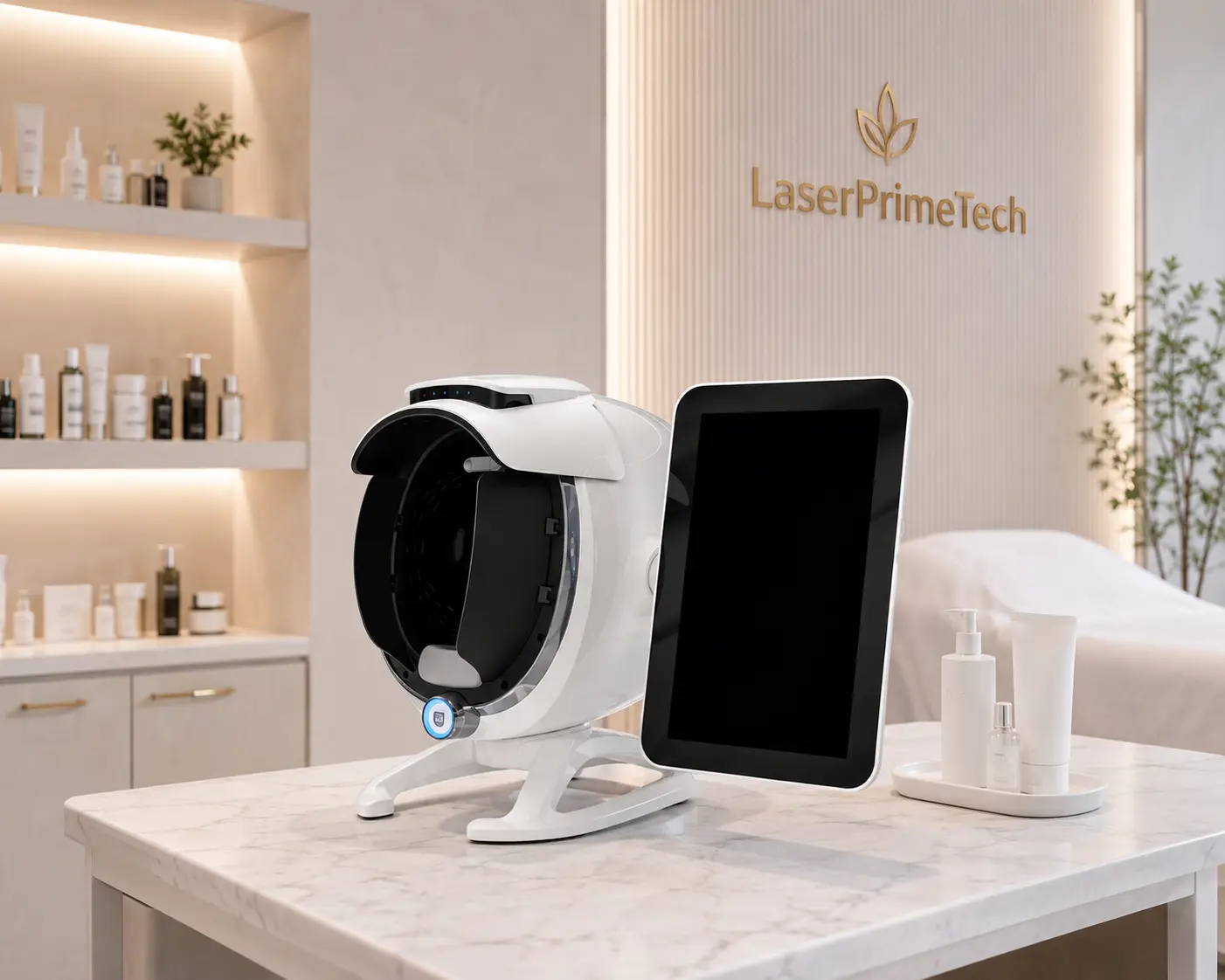
Introduction
Many beauty salons face the same challenge: despite significant investment in treatment equipment, advertising, and staff training, revenue per customer remains stagnant.
Why do customers visit the salon yet decline high-end treatments?
A key reason is that they do not fully understand why they need such treatments.
This is where technology comes in, allowing salons to visually demonstrate skin issues to the customer.
Skin analyzers transform traditional verbal consultations into a tangible experience backed by concrete data.
Why Do Beauty Salons Struggle to Increase Revenue Per Client?
Clients cannot see the skin issues being pointed out
Without the use of diagnostic equipment, if an aesthetician simply states, “You have pigmentation issues,” the client may well think to themselves, “It doesn’t seem that serious to me.”
Skin analysis devices make issues such as pigmentation, UV damage, enlarged pores, and redness visually apparent, making it easier for clients to understand professional recommendations. A key function of professional skin analyzers is to transform skin conditions invisible to the naked eye into clear images and data.
Clients fear being pressured into buying unnecessary treatments
Many clients harbor the suspicion that “the salon just wants to sell me a package, regardless of whether it’s actually right for me.”
Salons should therefore shift their business approach: instead of simply pushing treatments, they should first conduct a skin analysis and then offer a tailored improvement plan. Clients are far more likely to accept recommendations made this way.
Traditional visual assessments are too subjective
In the past, skin assessments relied heavily on the aesthetician’s personal experience.
In contrast, skin analysis devices generate standardized images and reports, providing a factual basis for the consultation.
How Does a Skin Diagnosis Machine Increase Beauty Salon Revenue?
1. Boost Service Conversion Rates
This is a crucial revenue stream for the salon.
Standard consultation process:
Communication/Consultation → Care recommendations → Customer decides independently
Process using a skin analyzer:
Skin scan/analysis → Visual imaging → Professional explanation → Personalized recommendations → Execution of relevant treatments
Scenario example:
A customer visits for a basic facial.
The analysis report reveals: excessive sebum, enlarged pores, pigmentation, and uneven skin tone.
The aesthetician can then naturally recommend a combined treatment plan addressing deep cleansing, hydration, and pigmentation correction.
The focus here isn’t on hard-selling services, but on providing recommendations tailored to the customer’s actual skin condition; this makes the advice easier to accept and establishes the salon’s professional credibility.
2. Increase Average Transaction Value
This represents a further step up from simply increasing conversion rates.
Example:
A customer initially plans to spend $80 on a single facial.
After a comprehensive skin analysis and consultation, they are more likely to opt for a $250 personalized treatment plan or a $500 multi-session package.
The logic flow:
Skin analysis → Identifying multiple skin issues → Planning a treatment regimen → Bundling services
Skin analyzers help salons move beyond selling one-off services and shift toward selling comprehensive, customized skincare programs.
3. Increase Sales of Treatment Packages
This is vital for salon owners.
Without skin analysis:
Customer: “I’ll just have a simple facial.”
After skin analysis:
You can offer the customer various package options, such as a 4-week hydration program, a pigmentation correction series, or an anti-aging treatment plan.
4. Drive Skincare Product Sales
While competitors often mention product sales, let’s look at this from the perspective of business profitability. Traditional sales approach:
Esthetician: “This serum works wonders.”
Customer’s inner thought: “Do I really need to buy this?”
Sales logic utilizing skin analysis:
Identify skin issues → Present visual evidence from the analysis → Recommend suitable skincare products
For example:
Dry skin → Recommend hydrating products;
Excess sebum → Recommend oil-control products;
Pigmentation → Recommend brightening products.
This shifts the focus from merely pushing products to providing personalized skincare solutions. Industry data shows that skincare product sales are a significant component of the return on investment (ROI) for skin analysis devices.
5. Offering paid skin analysis services
This is an excellent profit model.
Option 1: Free skin analysis
Purpose: To identify potential clients. For instance, new customers receive a free analysis upon visiting, with the goal of converting interested prospects into paying clients for treatments.
Option 2: Paid skin analysis
Example: Charge $30–$50 for a professional skin analysis;
If the customer subsequently purchases a treatment package, the analysis fee can be deducted from the total cost.
This approach filters out visitors who only want the free service without any intention to spend money. Many beauty salons have already turned comprehensive skin analysis into a standalone paid service.
6. Driving repeat purchases through “before-and-after” comparisons
This step is crucial.
Customer visits for the first time; perform a baseline skin analysis to capture initial data
→ Administer the appropriate treatment
→ Customer returns for a follow-up after 4–8 weeks
→ Perform skin analysis again
→ Compare “before” and “after” reports side-by-side
Customers can visually see changes in pigmentation, pores, wrinkles, skin texture, and redness. They genuinely perceive the treatment’s effectiveness, making them more willing to book future appointments, purchase service packages, and commit to long-term skincare plans.
From a business perspective, this effectively increases the customer’s lifetime value.
7. Boosting customer retention and lifetime value
This is the culmination of all the benefits mentioned above.
Traditional beauty salon model:
Customer pays for a single treatment and leaves immediately after it is finished. Data-Driven Operational Model:
Skin analysis → Treatment administration → Follow-up & maintenance → Re-examination & re-analysis → Updating the treatment plan → Skincare product recommendations → Ongoing repeat purchases
The ultimate goal for the store is not merely to close another facial treatment sale, but to increase customer lifetime value.
How Much Additional Revenue Can a Skin Diagnosis Machine Generate?
A Simple Revenue Calculation Example for a Beauty Salon
Consider this example:
100 customer consultations per month
Current service conversion rate: 25%
Average service price: $150
Monthly service revenue:
100 × 25% × $150 = $3,750
If using a skin analysis device boosts the conversion rate to 35%:
100 × 35% × $150 = $5,250
Change in revenue:
An increase of $1,500 per month
An additional $18,000 in annual revenue
>Note: The above is for illustrative purposes only and does not guarantee actual business results.
Revenue Changes When Selling Skincare Products
Let’s factor in product sales for the calculation.
Example:
100 customers visiting the salon per month
20 of these customers purchase additional skincare products, with an average spend of $50 per person
Monthly skincare product revenue:
20 × $50 = $1,000
Annual skincare product revenue: $12,000
Total salon revenue equals service revenue plus skincare product sales revenue.
Skin Diagnosis Machine ROI: What Should Salon Owners Measure?
KPI | Before | After |
Consultation-to-treatment conversion | 25% | 35% |
Average treatment value | $150 | $200 |
Package purchase rate | 15% | 25% |
Product purchase rate | 20% | 30% |
Repeat visit rate | 40% | 50% |
Revenue per consultation | $37.50 | $70 |
Revenue per Consultation = Treatment Conversion Rate × Average Treatment Value + Product Revenue
ROI = Additional Gross Profit ÷ Total Machine Investment
How to Use a Skin Diagnosis Machine to Increase Revenue Without Aggressive Selling
Many customers harbor a common concern:
“Is this device merely a sales tool designed to pressure me into spending money?”
Beauty salons should take the initiative to dispel this worry.
Present analysis results before offering treatment recommendations
First, show the customer the images and data generated by the skin analyzer. Base your improvement recommendations on the actual conditions revealed by the analysis, rather than immediately pushing specific treatment packages.
Explain skin issues in plain, accessible language
When discussing the analysis report, avoid obscure technical jargon. Explain various skin issues in a way the customer can easily understand so they can grasp the current state of their skin.
Directly link skin issues to specific care solutions
For every skin condition identified during the analysis, explain the corresponding improvement method. Clearly articulate which specific skin concern each part of the plan addresses, ensuring your recommendations are evidence-based.
Offer multiple care plans and let the customer choose
You can categorize plans into different tiers, such as basic, standard, and advanced options.
During the consultation, avoid using phrases like “You absolutely must buy this package”; instead, leave the final choice to the customer.
Which Beauty Salons Can Benefit Most From a Skin Diagnosis Machine?
Facial & Skincare Salons
Core Focus: Skin consultation & analysis + Skincare product recommendations
These establishments primarily offer routine facial treatments and basic skincare maintenance. Skin analysis devices are mainly used to educate customers about their skin condition and help them understand specific issues; this drives sales of home-care products alongside basic in-salon treatments, catering to customers with standard daily skincare needs.
Med Spas
Core Focus: Treatment conversion + Package sales
Combining skincare with minimally invasive aesthetic procedures, these spas use diagnostic devices to identify various skin issues and leverage the results to close sales on treatments. They emphasize multi-session packages to encourage customers to commit to ongoing, progressive care.
Anti-Aging Clinics
Core Focus: Comparative aging data + Long-term anti-aging plans
Specializing in anti-aging, these clinics rely on diagnostic devices to detect signs of aging—such as fine lines, sagging, and photo-aging—that are often invisible to the naked eye. They maintain detailed records over time, using “before-and-after” data comparisons to create customized, long-term anti-aging regimens, with a strong emphasis on long-term client retention.
Acne Treatment Clinics
Core Focus: Detecting acne and underlying issues + Phased treatment plans
Dedicated to treating acne-prone and inflamed skin. Diagnostic devices reveal underlying inflammation, closed comedones (whiteheads), and sebum accumulation. Treatment is structured into phases based on diagnostic findings, with specific care protocols for each stage and ongoing monitoring of the skin’s recovery progress.
Luxury Beauty Clinics
Core Focus: High-quality, personalized consultation experiences
Catering to high-spending clientele, skin analysis is an integral part of a premium service experience. Rather than merely serving as a sales tool, the analysis involves a comprehensive, detailed interpretation that leads to a highly personalized, holistic skincare improvement plan, emphasizing service excellence and an exclusive, bespoke feel.
Skin Diagnosis Machine vs. Traditional Skin Consultation
Traditional Consultation | Skin Diagnosis Machine |
Visual inspection | Digital imaging |
Subjective | More standardized |
Hard to visualize hidden concerns | Visual comparison |
General recommendation | Personalized recommendation |
Difficult to track | Before/after tracking |
Limited sales opportunities | Multiple revenue opportunities |
What Features Matter Most for Revenue Generation?
Multi-Spectral Imaging
Accurately detects underlying pigmentation, latent inflammation, UV damage, hidden clogged pores, and other concealed skin issues.
AI Skin Analysis
Uses AI algorithms to automatically evaluate skin metrics, eliminating the subjectivity and potential errors associated with manual assessments while delivering standardized analysis results.
Automatic Reports
Generates professional, standardized reports with a single click—eliminating the need for manual compilation and significantly saving time for aestheticians.
Before-and-After Comparison
Visually demonstrates skin improvements following treatments, allowing clients to clearly see the results.
Client Data Storage
Permanently stores skin analysis data, records of skin issues, and treatment histories for every client, facilitating long-term tracking of skin conditions.
FAQ
Can a skin analyzer increase a beauty salon’s revenue?
Yes. When used effectively, it provides visual, data-driven skin analysis insights, thereby boosting treatment conversion rates, average transaction values, and product sales.
How does a skin analyzer drive treatment sales?
It reveals skin issues invisible to the naked eye. You can present the analysis results and link specific issues to treatment plans at various price points. Visualizing “before-and-after” results further encourages clients to book individual treatments or full treatment packages.
Can salons charge for skin analysis services?
Yes. You can offer free scans to attract potential clients or provide paid analyses where the fee is credited toward future treatments. This approach helps filter out non-serious prospects while allowing the analysis to function as a standalone service.
Can a skin analyzer improve client retention?
Yes. Stored skin profiles facilitate “before-and-after” comparisons during follow-up visits. Demonstrating tangible treatment results builds trust, encourages repeat bookings, and increases client lifetime value.
How long does it take to see a return on investment (ROI) with a skin analyzer?
The ROI timeline depends on consultation volume, conversion rates, and product sales. With proper staff training, many salons see revenue growth within a few months. Specific results vary by situation and cannot be generalized.
Is a skin analyzer a worthwhile investment for small salons?
It is highly valuable. You do not need to purchase top-tier hardware; instead, prioritize revenue-generating features such as multispectral imaging, automated reporting, before-and-after comparisons, and client profile storage. Avoid high-pressure sales tactics and focus on making treatment recommendations based on the analysis data.
Final Thoughts: A Skin Diagnosis Machine Is More Than a Diagnostic Tool
A skin analyzer should not be viewed merely as another piece of beauty equipment. It enables beauty salons to provide more professional consultations and offer clients more precise recommendations, ultimately leading to higher treatment conversion rates and a higher average transaction value.
If you are looking for a professional skin diagnosis machine for your beauty salon, pls contact us feel free